
Infrastructure you commit to in 2027 will probably run for years. Hardware refresh cycles, multi-year contracts and the cost of moving all point the same way: the choice of facility is hard to reverse. So it deserves more than a price comparison.
This guide gives IT and business leaders a short preparation plan and nine questions that separate a serious data center in Israel from simple rack rental. They draw on the experience of MedOne, Israel's largest data center provider, but they apply to any provider you evaluate.
What to prepare for in 2027
AI changes power and cooling needs. GPU clusters can need far more power per rack than conventional servers, and cooling becomes a design question, not an afterthought. If AI is on your 2027 roadmap, power per rack and cooling method belong in the first conversation.
Privacy duties are tighter. Amendment 13 to the Privacy Protection Law took effect in August 2025 and added obligations such as privacy officers and financial sanctions. Which duties apply depends on your organization and data. Ask your legal counsel, and use the Privacy Protection Authority's guide as the primary source. A data center in Israel supports your compliance work. It does not replace it.
Continuity must be testable. A recovery plan that nobody has exercised is an assumption. Plan for tests, not just documents.
Nine questions to ask any provider
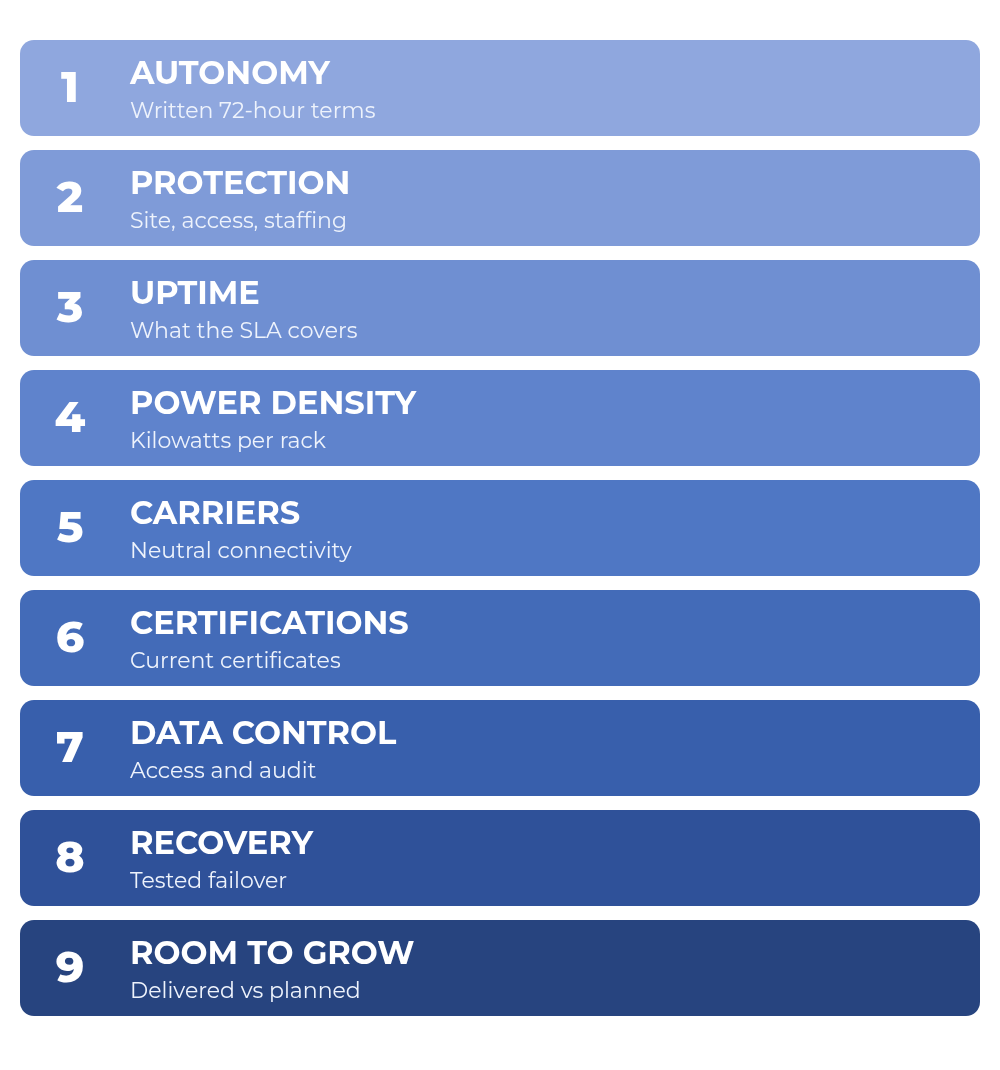
1. What happens when external services fail?
Redundancy means a backup exists. Autonomy means the site can keep operating without outside supply. At MedOne, 72 hours of autonomous operation is a contractual guarantee, supported by redundant power, on-site generators and fuel, and staffed operations teams. Whichever provider you choose, ask for the exact clause: which scenarios it covers, what capacity is guaranteed and what the exclusions are.
2. How is the site physically protected?
Look at location, construction, access control and staffing. MedOne's underground data centers across six sites are built for physical protection. Visit the site and ask to see the controls yourself.
3. What does the uptime figure really mean?
On a 365-day year, 99.9% equals about 8.76 hours of downtime, 99.99% about 52.6 minutes and 99.999% about 5.26 minutes. These are mathematical equivalents, not a forecast. Real SLAs have exclusions, maintenance windows and a measurement method. MedOne's SLA is 99.999%. Read the contract to see what it covers and what credit follows a miss.
4. What power density can it sustain for your racks?
Ask for sustained kilowatts per rack, for your site, on your delivery date. MedOne supports high-density deployments, including liquid cooling options for AI. Density is site-specific and design-dependent, so ask for the power and cooling plan for your exact deployment. If you want GPUs without buying hardware, also review GPU cloud in Israel.
5. Is it carrier neutral?
A neutral facility lets you use several carriers and negotiate each contract separately. MedOne's facilities are carrier neutral, with major Israeli carriers and cloud providers present. For latency-sensitive systems, connectivity often matters more than the price of the rack.
6. Which certifications does it hold?
Ask for current certificates and their scope. MedOne holds ISO 27001, 27017, 27799, 22301, 9001, 14001 and 45001, SOC 2 Type II and Vital Plant approval, listed on its security and standards page. Match each one to your own regulator's requirements.
7. Where does your data live, and who can see it?
Hosting in Israel is a starting point, not proof of compliance. Ask about physical access, logical separation, logging and audit rights. For regulated workloads, see which systems suit a sovereign cloud in Israel.
8. Is there a recovery option beyond hosting?
Colocation protects the primary site. You still need a tested way back. MedOne offers DRaaS in Israel built on HPE Zerto. Whichever provider you choose, ask for the recovery time you can expect and the date of the last failover test.
9. Is there room to grow?
Moving is costly and disruptive, so ask what capacity is available now and what is only planned. Separate operational capacity from roadmap. A plan is useful, but your contract should name what is delivered and when.
Three mistakes to avoid
Comparing price per rack alone. Power, cross-connects, carrier choice and outage cost can outweigh the rack fee. Compare the full cost over the contract term.
Accepting labels without evidence. Tier names, certifications and SLA claims each mean something specific. Ask what is certified, by whom, and what the contract promises.
Skipping the visit. Walk the facility. Ask to see power, cooling, access control and the operations room.
A practical 2027 plan
- Now: list workloads by power density, latency, data sensitivity and recovery needs.
- Early 2027: shortlist two or three providers, visit the sites and request draft contract wording for autonomy, SLA and exit terms.
- Mid 2027: pilot one workload and run a real failover test.
- Then: migrate in phases, critical systems last, with rollback plans.
The short version
Choose the provider that puts its claims in writing and lets you test them. Ask for the autonomy clause, the SLA definition, the power plan for your racks, current certificates and a recent failover result. A provider that answers these clearly, and welcomes a site visit, is usually worth a serious look. One that answers with brochures is not. That is how a 2027 plan becomes a decision you can defend.
Next step: talk to a MedOne cloud expert and test your workloads against these nine questions.
FAQ
How do I choose a data center in Israel?
Compare providers on autonomy terms, physical protection, SLA, power per rack, carrier neutrality, certifications, data controls, recovery and capacity.
What is colocation?
You own the servers and rent space, power, cooling, security and connectivity in a professional facility.
Does hosting in Israel make me compliant?
No. It can help with data location, but compliance depends on your obligations and controls.
Is an underground data center better?
It can offer strong physical protection. Judge the whole design, including power, cooling and operations.