
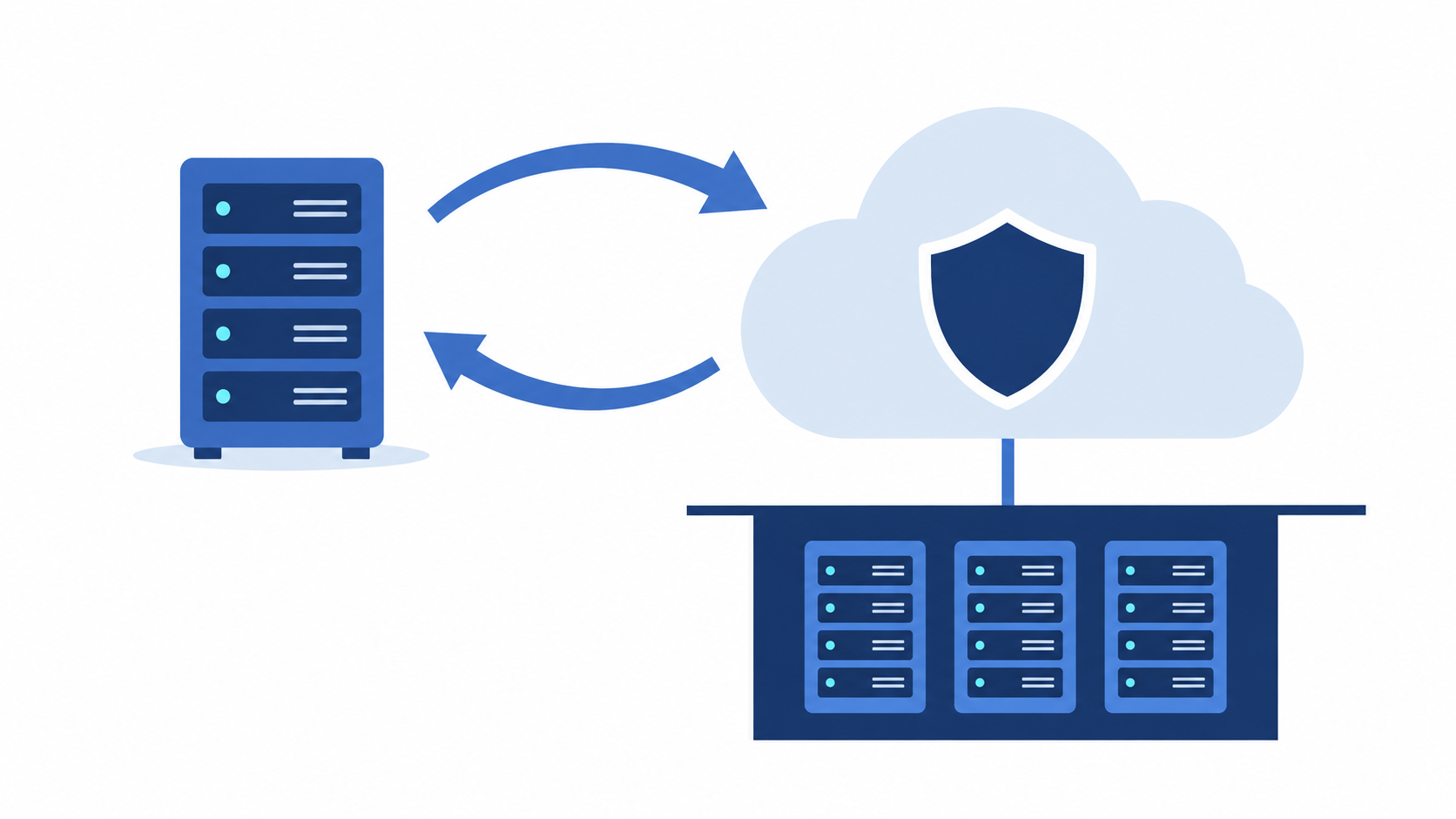
Backups tell you what you had. DRaaS gets your systems running again. This guide explains how DRaaS works, how to set recovery targets, and how MedOne, Israel's leading cloud provider, runs it on its own cloud in Israel.
What is DRaaS?
DRaaS, Disaster Recovery as a Service, replicates your systems to a cloud and lets you restart them there when the primary site fails. The provider operates the platform, and you keep a recovery plan that is tested, not just written. Compared with a second physical site, you do not pay for idle servers that wait for an emergency.
What does DRaaS protect against?
- Cyberattacks: in a ransomware scenario you can "rewind time" to the seconds before files were encrypted.
- Outages: a storage failure, a data system crash or a full site loss.
- Natural disasters and war: events that take a whole location offline.
- Human error: a deleted volume or a bad change.
RPO and RTO: the two numbers that decide everything
RPO, the recovery point objective, is how much data you can afford to lose. RTO, the recovery time objective, is how fast the service must be back. A payment system and a reporting server do not need the same targets, so set them per system. MedOne DRaaS targets an RPO of 5-10 seconds, and you choose the RTO that fits each system, from one minute to a few hours.
How does MedOne DRaaS work?
MedOne DRaaS is MedOne's own managed service, built on HPE Zerto technology. Your systems are replicated continuously to the MedOne cloud. If something fails, the organization keeps running from the MedOne cloud. MedOne's experts are on standby, prepare the processes and the playbook in advance, and test them with you. Recovery runs in MedOne's six underground data centers in Israel, so your data stays in Israel. Support is human, 24/7, in Hebrew and English.
How do you choose a DRaaS provider in Israel?
- Where does recovery run? Ask for the location of the facility and who operates it.
- Which targets are offered? Get RPO and RTO per system in writing.
- Is it managed? Someone should own the playbook and the tests, not only the software.
- Is it tested? A recovery plan you have never run is a guess.
- What does the data location mean for your rules? Hosting in Israel does not make a deployment compliant by itself, so review the design with your legal and security teams.
Where does DRaaS fit with the rest of your cloud?
DRaaS works well with a sovereign cloud in Israel for regulated systems and with a hybrid model for the rest. MedOne's long-term agreement with Broadcom, through 2033, also covers engineering assistance for new services focused on AI and sovereign AI. For the wider picture, read how to choose among cloud providers in Israel and An Israeli Cloud Provider for Enterprises.
Frequently asked questions
What is DRaaS?
Disaster Recovery as a Service. Your systems are replicated to a cloud, and you restart them there if the primary site fails. MedOne DRaaS is a managed service built on HPE Zerto technology.
What is the difference between DRaaS and backup?
A backup is a copy of data that you restore later. DRaaS keeps a running-ready copy of your systems and brings them back in minutes, with a tested recovery plan.
What RPO and RTO does MedOne DRaaS offer?
MedOne DRaaS targets an RPO of 5-10 seconds. The RTO is set per system, from one minute to a few hours. Exact terms depend on each customer's agreement.
Can DRaaS help after a ransomware attack?
Yes. DRaaS lets you return to a point in time seconds before the files were encrypted. It is one part of a security plan, not a replacement for it.
Where does MedOne DRaaS run?
In MedOne's underground data centers in Israel. MedOne operates six underground facilities.
Does MedOne provide DRaaS support in Hebrew?
Yes. Human technical support, 24/7, in Hebrew and English.